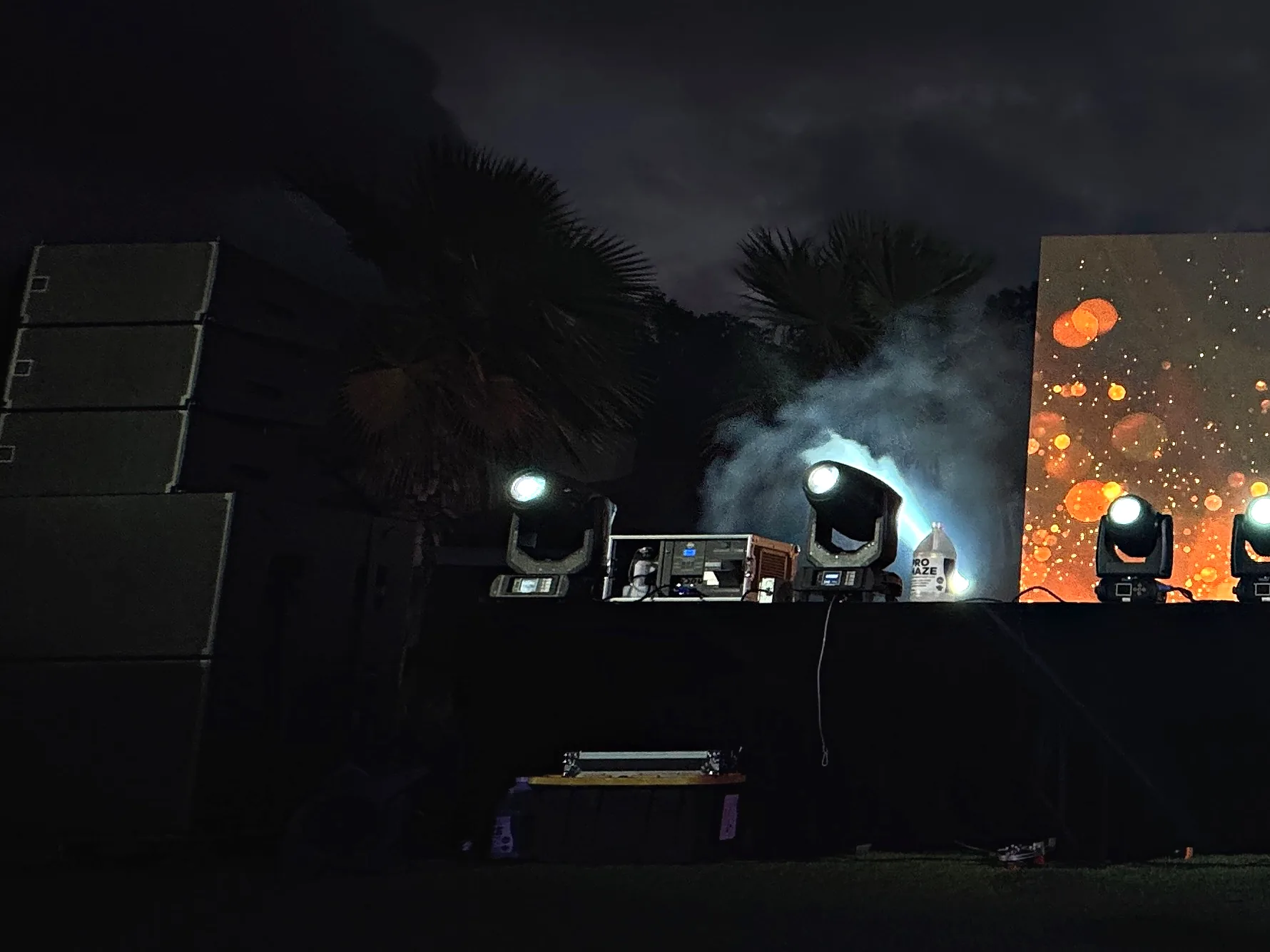
Indoors, the building does half the job. Outdoors, the job is the whole building.
A ballroom already has walls to fly light off, a roof, house power and whatever the room’s own fixtures contribute. An open field after dark supplies none of it.
A general session inside a hotel ballroom starts with a building already doing part of the work: a ceiling and walls to hang and bounce light off, an electrical service already run to the room, a roof that keeps rain off the gear, and a base level of ambient light from the room’s own fixtures that a designer either uses or fights. None of that exists on an open field after dark. The stage is a structure standing on its own, the light comes from fixtures with nothing else in the sky to compete with, the power comes off a machine parked on the grass, and the only light in the space before the show starts is whatever the sky itself is doing.
A video wall, moving lights, a line array and a set of CO2 effects are all disciplines this site covers indoors as well. The difference on a build like this one is that nothing is inherited from the venue, so each discipline is specified from its own defaults rather than from what the room already gives it for free.
Four and a half times the light indoors would need. Outdoors, none of it is competing with anything.
Outdoor LED is rated brighter than indoor LED for one reason — it has to beat the sky. After dark there is no sky to beat, and the brightness that reads at noon becomes the dominant light source over the crowd.
On the panel series this site works its figures from, the indoor 1.9mm line is published at 1,000 nit and the outdoor lines at 4,500 — four and a half times the output, because an indoor wall competes with a lit room and an outdoor wall competes with open sky. That figure is a daytime specification. It says nothing about what the same panel does once the sun the spec sheet was written against has gone down.
Run at anything near its rated ceiling in full darkness, an outdoor panel is, by a wide margin, the brightest object in the field. It stops being a screen the audience looks at and becomes a light source the audience sits inside, the same way a phone screen lights a dark room it was never built to illuminate. Wherever the crowd is close enough to the wall to be lit by it, that light is landing on faces whether the lighting design accounted for it or not.
Which is why an outdoor wall running at night is dialed down from the panel’s ceiling rather than up toward it, and why it gets treated as a fixture in the lighting plot rather than as a separate discipline running its own show. Moving heads and key light are balanced against whatever level the wall is actually running at, not against its published maximum — the same coordination a large, saturated surface always asks for, worked from the opposite direction daylight asks it from.
Where these figures come from
There is no service to tie into. The generator is the building.
Indoors, a wall this size is eventually a conversation with the venue’s electrician. Outdoors, on a field, that conversation never happens — every discipline on the job draws from the same machine, from the first watt.
Indoors, a video wall past roughly eight to ten square meters moves off a ballroom’s convenience outlets and onto a distro fed from a tie-in to the building’s own service — a location, a cable run and an electrician’s schedule, all facts about the venue rather than the production. On an open field there is no service to tie into, so that step does not happen at a size threshold; it does not happen at all. The stage lighting, the video wall, the line array and the CO2 effects share one machine from the first watt, because a machine is the only utility on site.
The math that sizes it is the one already published for the same wall indoors: on the outdoor line, published figures run 200 to 267 watts per square meter through normal content and 600 to 800 on a full-white frame — roughly a third of maximum on average, which is what a generator actually burns for most of the night. Add the stage lighting’s own average draw and whatever the sound system and the CO2 equipment pull, and the generator is sized on the sum of those averages plus headroom, not on everything at full output at once, because everything at once for the length of a show is not what actually happens.
The wiring downstream is sized differently, and on purpose: breakers, cable and the distro itself have to survive the moment the wall shows a full-white frame at the same instant a lighting cue peaks — the worst moment, not the average night — which is the same average-versus-maximum split this site uses for a building’s own service. Generators from 6 to 80 kW and distribution in all sizes and types with soco cover both ends of that range, from a single small fixture package up to a full night production drawing everything off one machine.
CO2 is a consumable with a pressure rating. Not a switch.
A lighting cue can be re-run and a video loop can be restarted. A CO2 blast spends a fixed, weighed supply the moment it fires, which makes it a logistics decision as much as a look.
Every other effect on this job runs from a supply that does not run out mid-show — power, video and light are metered, not consumed. Carbon dioxide is stored as a liquefied gas under real pressure: at room temperature, a full cylinder sits at roughly 830 psi, the substance’s own vapor pressure at that temperature. That is what makes a CO2 supply a pressure vessel to be scheduled and handled, not a canister that gets plugged in and forgotten.
A jet fixture discharges that supply at a rate manufacturers publish in their own equipment manuals — one published spec rates its unit at 0.5 kilograms per second, close to a pound of CO2 for every second the valve is open — so every cue on a run sheet is also a quantity drawn against a fixed number of tanks on site. Published safety guidance keeps the blast itself short, typically three to five seconds, and keeps the audience outside roughly five feet of the discharge’s direct line — both are standing practice across the industry, not a one-off house rule.
What that adds up to is the reason CO2 reads on this site as a logistics item rather than a lighting one: a light cue that misses can be brought back up a half-second later, and a video cue that stutters can be restarted from the top, but a CO2 charge that fires is gone, and the next one only exists if a tank on site still holds it. Tank count, swap timing between sets and standoff distance are decided before the show starts, on a schedule, rather than adjusted live the way a light level is.
Where these figures come from
- The vapor pressure of carbon dioxide at 20 °C — 5.7292 MPa, 56.54 atm, about 830 psi — the physical constant that makes a CO2 supply a pressure vessel
- A CO2 jet fixture’s published discharge rate — 0.5 kg/s (1.1 lb/s) — MagicFX CO2 Jet operating manual
- Published blast-duration and standoff-distance guidance for CO2 special effects
Rain is planned around. Wind is engineered for.
A ballroom’s four walls take the weather off the rig by existing. On an open field, the structure and the wiring have to survive it on their own.
A structure raised indoors is not fighting anything — a building’s own walls and roof already keep wind and rain off whatever is inside them, so ground support for a truss tower or a video wall is really only carrying its own weight. The same structure standing alone on a field carries wind as well, because there is no wall next to it doing that job for free. Ballast and rigging for an outdoor, ground-supported build are sized against that load from the start, not added after the fact.
Power tells the same story. Temporary electrical service run outdoors is wired and protected for a wet location — different connectors, different bonding, different enclosures — than the same load plugged into a ballroom’s house circuits, because the difference between the two locations is whether rain can reach the connection at all.
Weather is a call made before the show rather than during it, because the failure modes on an open field are structural and electrical rather than aesthetic — a wind load a ground-supported structure was not engineered for, or a downpour reaching a connection that was not rated for it, are decided against in the site plan and the rigging drawing, not worked around once the crew is standing in it.
Send the layout of the site, and what’s supplying the power.
Where the stage sits, how far the generator has to be from it, and whether a building is anywhere in reach decide the power plan, the rigging and the light before anything else does.
No client, no venue and no headcount goes on this. The city does, because it is a city, and what we supplied does, in the words it was described to us in.
Send the layout of the site and what power is available on it, and the answer comes back sized off an actual field rather than the worked figures above.
Call (561) 750-4070 or email [email protected]. If you would rather see how the number is arrived at first, how we scope a project sets out the nine drivers in the order they move an estimate.