Cost guide · South Florida · Figures as published and read on September 11, 2026
What corporate event production costs in South Florida — the numbers this market publishes, and the arithmetic between them.
A one-day general session in a single room typically runs $25,000 to $75,000. That is AVFX’s published 2026 tier for a build with standard staging, clean audio, one screen or one wall and no streaming — a market range from another production company, not a quote. What follows breaks four common builds into the parts a planner recognizes, and every figure in it is either traceable to a document you can open or worked step by step so you can redo it for your own job. Where this market publishes nothing — and on several lines it publishes nothing at all — that is said plainly rather than estimated around.
Four builds as ranges · a published labor card · what late costs · in-house against independent · every figure cited and dated
Producing since
2004
Events delivered
1,000+
AV inventory
100% owned
Crew
Permanent staff
01 — Four builds, as ranges
The answer first. Then who published it, and what inside it can be checked.
Each range below is another company’s published figure and is attributed
to them by name. Underneath each one is a line that can be computed from
a document rather than estimated — a convention center’s labor card, a
building’s utility card, a manufacturer’s watts per square meter — so the
range has something solid in it rather than only a span.
One thing these ranges deliberately do not do is split into
percentages by discipline. No published source breaks a
whole-event figure down into audio, video, lighting and staging
shares, and a split invented to look tidy would be the least
reliable number here. So each build lists its parts in the order they
appear on an estimate, names the one that moves the total most, and
prices the parts that a published document can actually price.
A one-day general session
One room · one day · a mid-size corporate audience
$25,000 to $75,000
AVFX’s published 2026 tier for a single-room general session — “standard staging, clean audio, projection or single LED wall, basic lighting, no streaming”.
The commonest brief in this market, and the one most planners are trying to price when they type a cost question. One room, one screen or one wall, a lectern and a panel, and everybody out by six.
Video and LED One surface. Whether it is projection or LED is the decision that splits the bottom of this range from the top, and pitch follows seating depth rather than budget.
Audio Room size and shape, how many open microphones, and whether the program needs monitors and a second operator.
Lighting Wash and key for the stage, and enough front light to make faces read on camera if anything is being recorded.
Staging and rigging A low deck and a header, or a ground-support tower if the room has no certified points where the surface needs to be.
Crew and labor moves it mostThe one line on a one-day build that can be computed from a published document rather than estimated — see the Broward card below. On a single show day it typically lands around a fifth of the bottom of this range before load-in and strike are counted.
Show power Usually the room’s own circuits at this size, which is why power rarely appears as its own line until a wall goes in the air.
Freight and load-in A truck and a dock slot. What moves it is the window, not the distance — a room released at midnight is a different number from the same room released at eight.
The labor line on one show day, from a published card
Broward’s published production card puts an A1, a V1 and a lighting designer in the “high-end operators” class at $98.00 an hour, and a stagehand at $62.00, with an eight-hour minimum on operators and time and a half after eight hours on a workday.
Three operators on the eight-hour minimum: 3 × 8 × $98.00 = $2,352.
Four hands on a ten-hour day, eight at straight time and two at time and a half: 4 × (8 × $62.00 + 2 × $93.00) = 4 × $682.00 = $2,728.
Together $5,080, and the card says 7 percent Florida sales tax is added to the labor bill, so $5,435.60.
One show day of technical labor at one building’s published rates is about a fifth of the bottom of the published range for the whole build — and that is the show day only. Load-in, strike and any rehearsal are separate calls with their own minimums.
A multi-day conference with breakouts
Three days · a general session and concurrent breakout rooms
$175,000 to $350,000
AVFX’s published 2026 tier for a multi-day conference — “multiple breakout rooms, larger LED footprint, dedicated control crew per room, integrated streaming and capture, speaker rehearsal time built in”.
The build where the count of simultaneous rooms, not the size of the main room, decides the number. Every concurrent room is a control position, a crew call and a set of minimums of its own.
Crew and labor moves it mostMultiplied by rooms and by days, and it is the multiplication that catches people. An operator minimum applies per call, per room — a ninety-minute breakout still bills the minimum.
Video and LED One larger surface in the general session and a repeatable, smaller package in every breakout. Standardizing the breakout package is the single biggest saving available on this build.
Streaming and capture AVFX puts a real hybrid build at “twenty to forty percent on top of the in-room AV budget”. It is an encoder, an uplink, an operator and a second mix, in every room it is offered in.
Rehearsal Speaker rehearsal is in the published scope of this tier for a reason: on a multi-day program it is the only thing standing between a slide deck arriving late and a general session running long.
Audio and lighting Repeatable per room, which makes them the predictable part of this build rather than the volatile part.
Staging and rigging One drawing for the general session, and then a question about whether the breakouts hang anything at all. Usually they should not.
Internet and connectivity Priced per drop per day by the building, not by the production company, and ordered early or paid for late. Worked below.
Ten breakout rooms for three days, from the house
Palm Beach County Convention Center’s exhibitor kit publishes a meeting-room package — projector, built-in roll-down screen, house sound and patch, a wireless microphone, a four-channel mixer and set-and-strike labor — at $1,500 per room per day ordered 14 to 90 days out.
Ten rooms for three days is thirty room-days: 30 × $1,500 = $45,000 as printed.
The same kit states that all audio-visual equipment “is subject to 20% management fee and all applicable taxes”, and puts Florida sales tax at 7 percent: $45,000 × 1.20 × 1.07 = $57,780.
The house number is 28.4 percent above the figure on the card, and the card also says floor rates are not available for audio-visual at all — order late and the answer is no, not more. That $57,780 is the figure any other arrangement has to beat or accept, before a single decision about the general session has been made.
An awards night or gala with a show element
One night · a running order, walk-ups and playback
$75,000 to $175,000
AVFX’s published 2026 tier for a branded build — “branded staging package, moderate LED wall coverage, scenic elements, intermediate lighting design, presentation playback, optional simple stream”.
An awards night is a general session with a clock. The equipment list looks like a conference; the cost behaves like a broadcast, because everything in it has to happen in an order, on a cue, once.
Rehearsal and show calling moves it mostEvery award is a cue: a name, a graphic, a light change, a walk-up and a music sting. A running order is rehearsed or it is discovered live.
Lighting The line that separates a gala from a meeting. Intelligent fixtures and a designer who has programmed looks per segment, rather than a wash that stays on all night.
Video and LED Playback per award, IMAG so the back of a banqueted room can see a face, and a surface wide enough to carry scenic content between segments.
Scenic and staging Where the “branded staging package” in the published scope goes. Stock versus shop-built is the choice, and it is a lead-time question as much as a money one.
Audio Banquet rounds, a band or a DJ changeover, and speech intelligibility over four hundred people eating. Harder than a conference, consistently underestimated.
Crew and labor A single long day, which is where overtime thresholds and the midnight-to-seven window start to bite. Worked below.
Freight and load-in Often into a room that had lunch in it, which compresses the window and is the reason this build so often becomes an overnight.
What four hours of rehearsal actually bills
Four hours of technical rehearsal is the minimum this company has published for a complex general session, and a gala with a running order is the case it exists for.
Broward’s card sets an eight-hour minimum on operators. Three of them at $98.00 — audio, video, lighting — do not bill four hours: 3 × 8 × $98.00 = $2,352, against the $1,176 that four hours suggests.
With the 7 percent sales tax the card adds to labor, $2,516.64.
Rehearsal does not cost half a day. It costs a day, and a gala usually needs two of them — one to build the look and one to run the order. That is the most commonly missing line on a gala budget, and it is missing because a four-hour call sounds like four hours.
An outdoor build with no house power
A lawn, a deck or a street · no building to plug into
No published range exists
and that is the honest answer — no source in this market publishes a figure for temporary power or tenting, because the site sets it.
A ribbon cutting on the building being opened, a party on a lawn, a runway on a pool deck. The AV looks like the indoor build. Everything under it is different, and none of it is published anywhere.
Show power moves it mostThe line that exists here and nowhere else. A machine, fuel, a distribution run and somebody watching it, sized from average draw and wired for the full-white maximum.
Tenting and structures A permit cycle, not a canvas order. Miami-Dade requires a building permit for any tent larger than 10 ft × 12 ft, with structural calculations, a Class A flame-spread certificate and a Florida licensed architect’s or engineer’s seal on the plans.
Flooring and ground Whether the ground takes a stake or the structure has to be ballasted, and whether the deck needs levelling before anything stands on it.
Video and LED Outdoor pitch and outdoor brightness, which is a power decision before it is a picture decision.
Weather contingency Not a line anyone publishes and not a line anyone should skip. In this market between May and October it is the difference between a delay and a cancellation.
Crew and labor Longer, because a site build starts from nothing. There is no house sound to patch and no dock to push from.
What a building charges for the power a generator replaces
A 20 × 10 ft outdoor wall works out at about 18 kW sized on maximum plus headroom — the arithmetic is on the LED page, worked step by step from a manufacturer’s published watts per square meter.
Palm Beach publishes a 208V three-phase 100A feed at $1,270 ordered 14 to 90 days out. That feed is 1.732 × 208 × 100 = 36.0 kVA, or 28.8 kVA usable after an 80 percent continuous-load derate.
So a four-figure line on a published card covers that wall with room left over for the lighting rig.
Where a building has the feed, show power is a known, published, four-figure line. Where there is no building, the same load is a machine in the 6 kW to 80 kW range, a cable run whose length nobody knows until the site walk, and a person on it all night — and no published South Florida source puts a number on that. It is the largest genuinely unpublished line in this market.
The last of the four is the honest one. There is no published range for
an outdoor build in this market because the site sets it, and the parts
of it that can be calculated in advance — the electrical load,
the circuit count, the generator size — are worked in full on
the LED video wall page rather
than repeated here.
02 — Why the published totals disagree
One published benchmark puts production at 19 percent of an event budget. Another works out at 62 percent. Both are right.
Two of the most quotable published numbers about event budgets cannot both be describing the same event. Reading them side by side is more useful than averaging them, so here they are side by side.
GoGather published 2025 benchmarking in April 2026 with audio-visual at 19 percent of budget and an average spend of $288,000, food and beverage at 32.5 percent and $525,000, housing at 11 percent and $170,000, and airfare at 4 percent and $87,000. Divide each dollar figure by its own share and the implied total budget comes out at $1.52M from the audio-visual line, $1.62M from food and beverage, $1.55M from housing and $2.18M from airfare. Those are not one event. The shares and the averages are drawn from different subsets of the same book of business, which the note on the page allows for — it says the data is pulled from the budgets and hotel contracts that firm manages, and it discloses no sample size.
AVFX, writing about Florida in March 2026, puts a mid-size conference of 200 to 800 people at $75,000 to $250,000 in total and the audio-visual and production inside it at $50,000 to $150,000. Take the midpoints and production is about 62 percent of that total — against GoGather’s 19 percent.
Both are right, and the gap between them is entirely about what the word “budget” contains. A percentage-of-budget rule tells you nothing until you know whether the budget includes food, hotel rooms and flights. Put those in and production lands near a fifth. Leave them out — which is what a planner buying production is actually holding — and production is most of it. This is why a “spend 10 to 15 percent on AV” rule of thumb produces a number nobody can build, and why an absolute range is worth more to you than a share.
The practical version: price the build, then check the share, and never the other way around. If a share is the only number you have, the room is already designed by accident.
03 — What a crew hour costs here
One building in this market publishes its technical labor rates in full — classifications, minimums and the overtime triggers.
One building in South Florida publishes its technical labor rates in full, with the classifications, the minimums and the overtime triggers. It is the Greater Fort Lauderdale / Broward County Convention Center, the card runs from October 1, 2026 to September 30, 2027, and it is the firmest cost figure published anywhere in this market.
The Center has an exclusive agreement with IATSE Local 500 for technical service labor and operators on the facility grounds, and publishes what it calls “estimated rates for a production AV contractor at the BCCC”. The rates include, in the card’s own words, “all contractual benefits and payroll administration fees” — so they are a billed cost, not a wage, and they are not comparable to a wage figure from a salary aggregator. IATSE Local 500 publishes no public scale of its own; this card is the published route to those rates.
Greater Fort Lauderdale / Broward County Convention Center, published
production rates, October 1, 2026 – September 30, 2027. The overtime
column is the card’s straight-time figure multiplied by 1.5.
Classification
Straight time, per hour
Time and a half, per hour
Stagehand
$62.00
$93.00
Department head
$66.00
$99.00
Rigger
$71.00
$106.50
Equipment operator
$85.00
$127.50
Certified head rigger
$85.00
$127.50
High-end operator / camera operator
$98.00
$147.00
Straight time and the time-and-a-half rate derived from it. The card defines “equipment operator” as A2, V2, master electrician, graphics, playback, recordist, ETCP certified technicians and spotlight, and “high-end operator” as A1, V1, technical director, lighting designer, board operators, large-format audio consoles, video switchers, FCC licensed RF coordinators, camera, licensed pyro and teleprompter. Fractions are paid to the hour and 7 percent Florida sales tax is added to the final labor bill.
Four-hour minimum on every call
Including load-in and show-out. A ninety-minute strike with one hand bills four hours at $62.00 — $248.00 for an hour and a half of work. On a build with three short calls rather than one long one, that is the whole of the difference.
Eight-hour minimum on operators
The most expensive line most planners do not know exists. A two-hour rehearsal call for an A1 bills eight hours at $98.00 — $784.00, not $196.00.
Time and a half between midnight and 7am
And all day Sunday, and after eight hours on a workday. This is what an overnight load-in costs, and it is set by the room contract rather than by the show.
Meal penalty after five hours
Paid at time and a half of the prevailing rate until relief. A compressed load-in that skips a break does not save the hour; it buys the hour back at a premium.
What moving a load-in into the overnight window does
Twelve hands on a six-hour push, in daylight: 12 × 6 × $62.00 = $4,464.
The same twelve hands on the same six-hour push between midnight and 7am, at the card’s time-and-a-half rate of $93.00: 12 × 6 × $93.00 = $6,696.
With the 7 percent sales tax the card adds to labor: $4,776.48 against $7,164.72.
A $2,232 difference — exactly 50 percent on that line — for the same work by the same crew, decided by a clause in the room contract about when the space is released. It is the largest single swing available on a build of this shape, it is negotiated with the venue rather than with a production company, and it is usually settled before anyone has drawn the show.
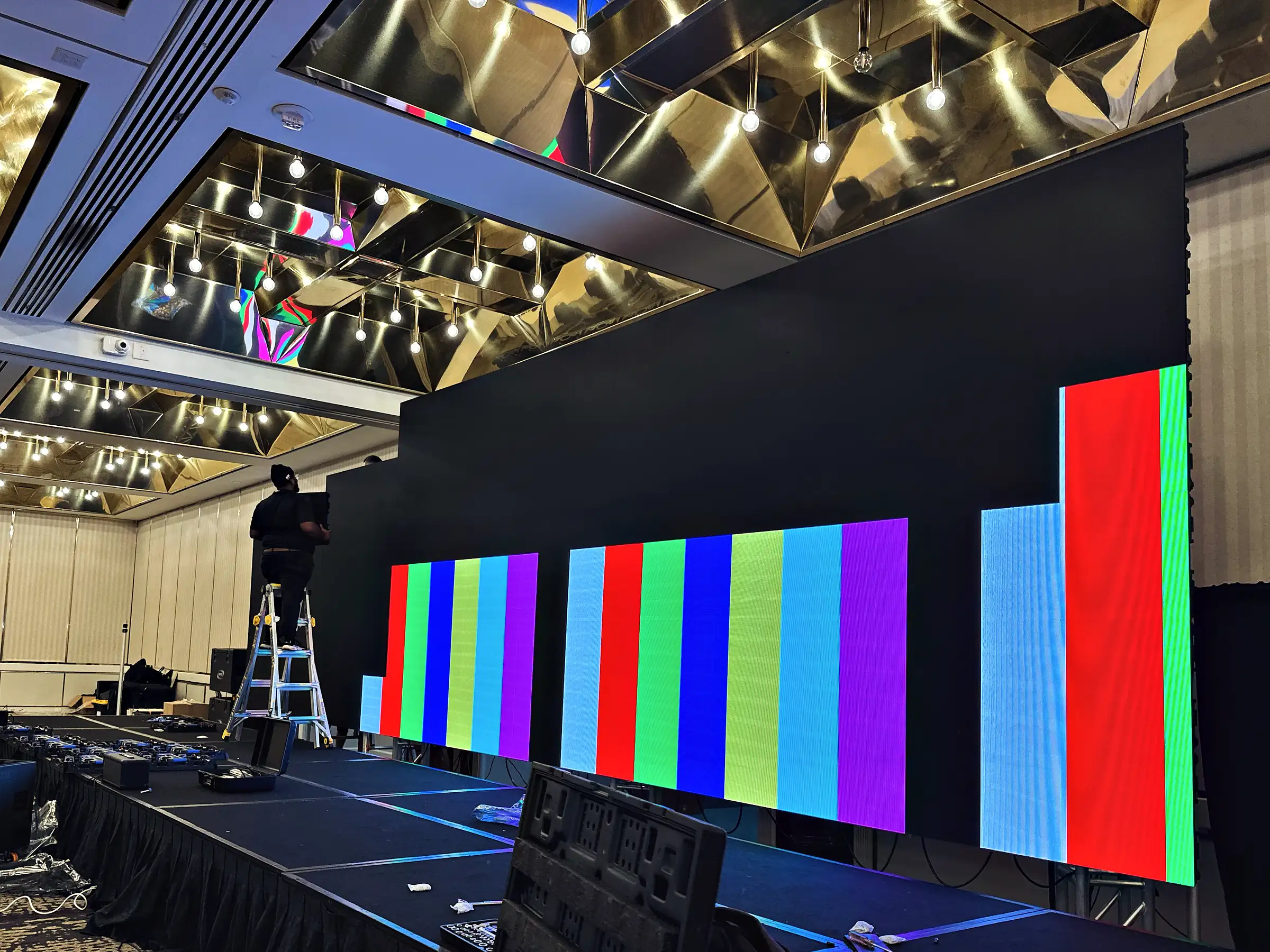
Build hours — a technician at the end of the wall, before anything is shown on it
04 — What the building charges
Ordered on the show floor instead of two weeks out, the same circuit costs about 1.8 times as much.
A convention center publishes the part of the bill a production company never sees and a planner always pays. Palm Beach County Convention Center puts its whole exhibitor kit online, and three patterns in it are worth more than any single figure.
The kit is a utility and services card for one building and it was last revised on January 1, 2024, so read it as a floor rather than as today’s price. The patterns below are ratios inside the card, which survive a reprice in a way the figures themselves do not.
01
Late is a multiplier, not a fee
The kit prices everything three times — advance, 14 to 90 days out; standard, 3 to 13 days; floor, onsite to 2 days. A 120V 20A circuit is $170 advance and $305 on the floor. A 208V three-phase 100A feed is $1,270 advance and $2,290 on the floor. That is not one line: the card prices twelve electrical and overhead feeds at all three windows, and on every single one the floor rate lands between 1.79 and 1.83 times the advance rate. It is a deliberate policy, not a spread. AVFX, independently, puts engaging a production company twelve or more weeks out at “twenty to twenty-five percent below” the same scope booked under six weeks out. Two unrelated sources, one direction.
02
The same circuit costs 2.3 times as much in the air
A 20A 120V circuit delivered to the floor is $170 in the advance window. The same 20A 120V circuit delivered overhead, to a rigged sign, truss or wall, is $390 — 2.3 times. Seven of them, which is what a 20 × 10 ft indoor wall wants after the NEC derate, is $1,190 at floor level against $2,730 in the air. That is the same $1,540 whether the wall is beautiful or not, and it lands before anyone has priced a motor. It is the clearest published answer to why a flown wall is not the same build as a ground-supported one.
03
A management fee and a tax sit on top of every printed figure
The kit states that all audio-visual equipment “is subject to 20% management fee and all applicable taxes”, and gives Florida sales tax as 7 percent. Anything on that card therefore bills at 1.284 times the figure printed next to it — 28.4 percent above the number a planner wrote down. Wired internet is $150 per drop per day in the advance window and $275 on the floor, so three drops on a four-day show — stage, front of house, registration — is $1,800 ordered early against $3,300 ordered late, before the same uplift.
04
The rigging fee is trivial and the rigging deadline is not
Palm Beach asks for rigging plots “no less than (14) days prior”, reviews the first one free and charges $50 for each review after that. Three revisions is $100 — nothing. But each revision is a cycle against a fourteen-day wall, and a plot that misses it is a build that has to stand on the floor instead. Broward’s exclusive rigging provider reviews and approves every rigging plan and supplies the rigging supervisor for install, operation and dismantle. The money is a rounding error; the calendar is the cost.
05
The card disagrees with itself, so confirm the labor rate
The kit prints electrical labor at $75 an hour standard and $150 holiday on its electrical page, and its mechanical page carries a box headed the same way at $65 and $130. It also puts IT technician labor at $85 standard and $170 holiday. Two of those three are labeled identically and are not the same number. Both figures are in the same published document and the disagreement is worth knowing about rather than averaging away: get the rate for your trade in writing from the building before you budget it.
One more line from the same kit, because it is the one that decides whether a held date is a decision or an option: refunds run 100 percent at 45 to 90 days before the first move-in day, 50 percent at 14 to 44 days, and nothing at 13 days or fewer. A change of plan inside two weeks is not a change of plan, it is a purchase.
05 — What actually moves the number
Eight variables decide most of it, and five of them are settled before anyone draws the show.
In rough order of how much they move a total, with the arithmetic where
there is arithmetic and the question to ask where there is not. Clear
height, rigging points and the load-in window are room-contract terms —
which is why they are usually agreed by somebody who is not thinking
about production, and why they are the cheapest things on this list to
get right.
01
Clear height, and whether it is clear where you need it
Run the standard 8:1 furthest-viewer rule and the arithmetic settles the room before anyone argues about it. A seat 80 ft from the screen wants 10 ft of image width. A 16:9 image 10 ft wide is 5 ft 7 in tall. Put the bottom edge at 4 ft so the back rows see over the front rows and the top edge is at 9 ft 7 in — so the trim has to clear roughly 11 ft once there is a header on it. Palm Beach publishes 14 ft in its meeting rooms, 24.5 ft in its ballroom and 29.2 ft in its exhibit hall. The same show is a simple build in one of those rooms and a ground-support build in another, and that decides the rigging line, the labor line and how many seats fit.
Ask for: Ask for clear height at the screen end specifically. Ballrooms are frequently not flat overhead, and the number on the sales sheet is usually the best point in the room.
02
Rigging points, or the honest absence of them
A floor plan showing a ceiling grid is not a structural certificate. What matters is how many certified points exist where the screen, the lighting positions and the set actually need them, and what each is rated for. If the answer is none, the design is ground support: heavier, slower, and it takes floor area out of the seat count. The three South Florida convention centers each answer this differently, and two of the three hold the rigging themselves.
Ask for: Get the point count and the rating from the building’s engineer, in writing, before the room contract is signed rather than after.
03
The load-in window, and whether it is overnight
This is the largest single swing available on most builds and it is the one most often decided by someone who is not thinking about production. Broward’s published card pays time and a half between midnight and 7am, all day Sunday, and after eight hours on a workday. The worked example above puts a twelve-hand overnight push at 50 percent more than the same push in daylight. Nothing about the show changed.
Ask for: Negotiate the room release time as a production term, not as a courtesy. An extra evening is frequently cheaper than the overnight it avoids.
04
Who is allowed to touch it
Three buildings, three answers, and none of them changes what the show looks like. Broward has an exclusive agreement with IATSE Local 500 for technical service labor and operators, and an exclusive provider of motors, truss and rigging equipment who approves every rigging plan. Palm Beach is the exclusive provider of utilities and rigging in its own building. Miami Beach permits outside suppliers for certain non-exclusive services with prior approval by its management, holds internet exclusively to one provider and catering to another, and publishes no rate card of any kind.
Ask for: Ask for the exclusivity list in writing before signature. Afterwards it is no longer a negotiation, and it changes the crew plan rather than the design.
05
Rehearsal hours, priced honestly
Four hours of technical rehearsal is the published minimum for a complex general session, and under an eight-hour operator minimum four hours bills eight. Three operators at the Broward card’s $98.00 is $2,352 for that rehearsal, not $1,176. A program with a running order — an awards night, a launch, anything with a walk-up — needs two of those calls rather than one.
Ask for: Put rehearsal on the budget as a day, at the start. It is the line most often cut and the one whose absence is most visible from the third row.
06
Whether the content is finished before the crew arrives
Not a price, a schedule — and the schedule is where the money is. Content that lands during rehearsal turns one rehearsal into two, and a second rehearsal is another set of operator minimums at the rates above. It also moves graphics work onto show day, which is the one day on which nothing should be being made.
Ask for: Lock the deck two working days before the first rehearsal call. It is the cheapest decision on this list and the least often taken.
07
Surface size and pixel pitch
Pitch is a seating-distance decision, not a budget one: 1.9mm makes close seating and on-camera work honest, 4.8mm is what makes a large outdoor surface affordable to build, and 2.9mm sits in both an indoor and an outdoor build. Width is a different question from resolution, and scale is not linear — AVFX puts moving “from a single 16×9 center screen to a wraparound LED environment” at up to triple the staging cost.
Ask for: Fix the furthest seat first and let it choose the pitch. Choosing the pitch first is how a room ends up with a surface that looks wrong from exactly the seats that matter.
08
Power, and whether the room has it
A 120V 20A circuit yields 1,920 W usable after the NEC 80 percent continuous-load derate, and at 700 W/m² that is about 2.5 to 3 m² of wall per circuit. A 20 × 10 ft wall resolves to 72 cabinets and 18 m², which is about 4.2 kW on a show look and 12.6 kW at full white on a 1.9mm indoor panel — seven circuits. Past roughly 8 to 10 m² a wall is off a ballroom’s convenience outlets and onto a distro from a company switch. Average draw is what the job is specified from and what a machine burns; the full-white maximum is what the circuits, the breakers and the cable have to survive, because one holding slide gets there.
Ask for: Get the count of separate circuits, not the total amperage. Seven circuits on one breaker is one circuit.
Three of these are answered building by building rather than in
general, and the answers are published: the South
Florida venue guide sets out load-in, dock access, ceiling heights
and who each convention center lets you bring, cited to each building’s
own pages. The power and pitch arithmetic is on
the LED video wall page. What to
send us so a scope comes back quickly is on
how we scope a project, which carries no
figures at all — the two pages do different jobs on purpose.
06 — In-house AV against an independent
On the largest published book of business in the category, 38.6 cents of every dollar billed was commission to the building.
This is the decision most people reading a cost page are actually making, and the strongest evidence about it is not a competitor’s blog post. It is a registration statement filed with the Securities and Exchange Commission.
The commission is the largest line in the model
Encore Inc. — the largest in-house event technology company in the world, exclusive on-site provider at approximately 2,200 venues as of December 31, 2025 — filed a Form S-1 on April 10, 2026.
Its U.S. segment reported revenue of $2,830,639 thousand for 2025 and revenue-based commissions to venue partners of $1,093,782 thousand.
$1,093,782 ÷ $2,830,639 = 38.6 percent. The two prior years: 38.5 percent in 2024 and 38.5 percent in 2023.
For scale, the same segment’s workforce expense was 31.7 percent of revenue and equipment sub-rentals 4.2 percent. Segment profit was 14.3 percent.
On the largest published book of business in the category, a little under 39 cents of every dollar billed is a referral commission to the building — a larger line than the payroll of the people doing the work, and stable to a tenth of a point across three years. AVFX, writing from the other side, puts venue-exclusive AV at “thirty to fifty percent above” independent pricing. A company that collects the commission and a company that competes with it agree on the order of magnitude, which is about as close to a verified market fact as this subject gets.
What an in-house invoice actually looks like
The same filing gives a figure nobody else in this market publishes: average revenue per event in the United States of $9,700 in 2025, up from $9,000 in 2024 and $8,300 in 2023 — and nearly 88 percent growth on that measure since 2019. It also describes serving “events of all sizes, ranging from small meetings under $10,000 to large-scale conferences and trade shows exceeding $1,000,000”. So the median in-house engagement is a small room, not a general session. Most of what an in-house desk does all day is a projector, a microphone and a screen in a breakout — which is exactly the work it is best placed to win.
What in-house genuinely has, and it is not nothing
It is already in the building. No truck, no dock slot, no push down a corridor — and on a same-day request that is the whole game.
It has standing relationships with the chief engineer, the banqueting manager and the security desk. That is who you actually need at six in the morning when a breaker is out.
It sits inside the venue’s own insurance and indemnity arrangements, which is one fewer certificate to chase and one fewer party to a dispute if something is damaged.
Where the building patches the house sound system itself, in-house is on the right side of that boundary by default.
And it is genuinely cheap on a small, short, simple room-day. Palm Beach’s published meeting-room package at $1,500 a room-day in the advance window is hard to beat once a truck, a dock slot and a four-hour crew minimum are in the comparison.
So the straight answer, and it costs us work to give it: on a single breakout room with a projector and one microphone for one morning, house AV is very often the right call. The commission is real, but on a small room-day it is a percentage of a small number, and the logistics an outside company has to fund to get there are not. Where the arithmetic inverts is where the build has a flown surface, a rehearsal day, a running order, several rooms at once, or anything outdoors — because then the commission is a percentage of a large number, and owning the schedule and the inventory is worth more than being down the corridor. Any production company that tells you the answer is always the same one is selling, in whichever direction.
One more figure from the same filing, because it is the fairest one in
it: the company puts its own capture rate inside its contracted venues
at approximately 80 percent from 2019 to 2025. Roughly one job in five
in buildings where it is the exclusive on-site provider already goes to
somebody else. That is a market that has compared the two and split.
07 — What nobody publishes
Five things a planner reasonably expects to find priced, and the reason each one is not.
A cost guide is only as good as its admissions. Five things a planner reasonably expects to find priced in this market are not published anywhere, and in each case the reason is more useful than a guess would be.
Miami Beach publishes no rates at all
The largest building in the market publishes its provider list and not one figure — no labor card, no utility card, no service kit with prices. Broward publishes a dated labor card and Palm Beach publishes a full utility and services kit. So the building most likely to hold a major South Florida conference is the one that cannot be budgeted from a document, and everything for it has to come from the event manager by email.
The electrical contractor publishes nothing publicly
Edlen is the electrical contractor at Broward and an approved electrical provider at Miami Beach. Neither venue publishes its rates; Broward’s own page says custom electrical and utility order forms can be provided to exhibitors on request. The Palm Beach figures above are that building’s own in-house utility card and are not a proxy for the other two.
There is no published price for temporary power or tenting
Not a package, not a day rate, not a per-kilowatt figure — in this market, nowhere. The reason is that the site sets it: how far the machine sits from the distro, whether the ground takes a stake or needs ballast, whether the structure needs a permit at all. What is publishable is the load, and the load can be calculated in advance from the surface area and the pitch.
Permit fees are not on a public schedule in a usable form
Miami-Dade publishes the threshold and the requirements — a building permit above 10 ft × 12 ft, Florida Building Code and NFPA 102, structural calculations, a Class A flame-spread certificate and a Florida licensed architect’s or engineer’s seal — but the fee is not presented in a form anyone can budget from without an application. The requirements are the cost anyway: the engineering and the review cycle dwarf the fee.
No union publishes its own scale here
IATSE Local 500 does not publish a public wage scale. The Broward card is the published route to those rates and it is a card for one building — it includes contractual benefits and payroll administration, so it is a billed rate rather than a wage, and it cannot be lifted onto another venue.
And the dating matters more than any single number. The Broward card runs from October 1, 2026 to September 30, 2027, so it is current. The Palm Beach kit was last revised on January 1, 2024, which makes it more than two and a half years old at the time of reading — treat its absolute figures as a floor and its internal ratios as the durable part. Costs in this market move; an undated cost page is wrong within a year and does not know it.
08 — Asked and answered
The four questions this comes down to.
Short answers, with the same figures and the same sources as the sections
above.
What does a one-day corporate general session cost in South Florida?
AVFX publishes $25,000 to $75,000 for a single-room general session with standard staging, clean audio, projection or a single LED wall, basic lighting and no streaming, in its 2026 pricing guide. That is a market range published by another production company rather than a quote, and it was read on September 11, 2026. One line inside it can be checked against a published document: at the Greater Fort Lauderdale / Broward County Convention Center’s published rates, three operators on the eight-hour minimum at $98.00 an hour and four stagehands on a ten-hour day at $62.00 come to $5,080 of technical labor, or $5,435.60 with the 7 percent sales tax the card adds — about a fifth of the bottom of the range, for the show day alone, before load-in, strike or rehearsal.
What drives the cost of a corporate event more than anything else?
The load-in window, and specifically whether it runs overnight. The Greater Fort Lauderdale / Broward County Convention Center’s published production card pays time and a half between midnight and 7am, all day Sunday and after eight hours on a workday. Twelve hands on a six-hour push bill $4,464 in daylight and $6,696 in the overnight window — exactly 50 percent more for the same work by the same crew. It is decided by the clause in the room contract that says when the space is released, which is usually agreed before anyone has drawn the show. After that come clear height at the screen end, whether the room has certified rigging points where the surfaces need them, how many rehearsal hours the program really needs under an eight-hour operator minimum, and whether the content is finished before the crew arrives.
How does hotel in-house AV pricing compare with an independent production company?
Encore Inc., the largest in-house event technology company in the world, filed a Form S-1 with the SEC on April 10, 2026 reporting U.S. segment revenue of $2,830,639 thousand for 2025 and revenue-based commissions to venue partners of $1,093,782 thousand — 38.6 percent of revenue, and 38.5 percent in each of the two prior years. That commission is a larger line than the segment’s workforce expense, which was 31.7 percent of revenue. AVFX, from the other side, puts venue-exclusive AV at thirty to fifty percent above independent pricing. In-house has real advantages in return: it is already in the building, it has the relationships with the engineer and the banqueting manager, it sits inside the venue’s insurance, and on a small, short, simple room-day it is genuinely hard to beat — Palm Beach County Convention Center publishes a meeting-room package at $1,500 per room per day ordered in advance. The arithmetic inverts on builds with a flown surface, a rehearsal day, a running order, several rooms at once, or anything outdoors.
Can you bring your own AV company into a South Florida convention center?
Yes, at all three, and what differs is which part of the work the building keeps. The Greater Fort Lauderdale / Broward County Convention Center has an exclusive agreement with IATSE Local 500 for technical service labor and operators on the facility grounds, and an exclusive provider of motors, truss and rigging equipment who reviews and approves every rigging plan and supplies the rigging supervisor. The Palm Beach County Convention Center is the exclusive provider of utilities and rigging in its own building and asks for rigging plots no less than fourteen days before move-in. The Miami Beach Convention Center permits outside suppliers for certain non-exclusive services with prior approval by MBCC management, and holds internet and catering exclusively. Get the exclusivity list in writing before the room contract is signed, because it changes the crew plan and the schedule rather than the design.
09 — Sources
Every figure above came off one of these.
All read on September 11, 2026. Where a range belongs to another company, that
company is named in the sentence that uses it.
A range lets you place yourself. It does not tell you which room holds
your show, how many circuits your wall wants, or whether your load-in is
an overnight — and those are the three answers that turn a range into a
figure.