Where the winners sit is a schedule decision.
Everything else on an awards night is content. The walk is transit, it happens once per award, and it is the only part of the evening whose length is set by a distance somebody drew on a floor plan.
The federal manual that governs pedestrian signal timing tells you how long it takes an adult to cross a street: it computes the clearance interval at a walking speed of 3.5 feet per second. That is a deliberately unhurried number, arrived at by measuring people in public, and it is the right order of magnitude for somebody crossing a carpeted room in evening dress who has just been told their own name.
So take a running order of twenty-four awards — change the count, the arithmetic scales with it — and a ballroom where the furthest table is ninety feet from the bottom of the stage steps. Ninety feet at 3.5 ft/s is 25.7 seconds up and 25.7 back, 51.4 seconds of pure transit for one award, and 20 minutes 34 seconds across the whole running order. Seat the same people forty feet from the steps and the same twenty-four walks come to 9 minutes 9 seconds. The floor plan is worth 11 minutes 26 seconds of running time, and nobody has specified a single piece of equipment yet.
Transit alone, at a design walking speed, across 24 awards
| Furthest table to the steps | One way | There and back | Across 24 awards |
|---|---|---|---|
| 40 ft | 11.4 s | 22.9 s | 9 min 9 s |
| 60 ft | 17.1 s | 34.3 s | 13 min 43 s |
| 90 ft | 25.7 s | 51.4 s | 20 min 34 s |
| 120 ft | 34.3 s | 68.6 s | 27 min 26 s |
Distance divided by 3.5, doubled, multiplied by the number of awards. It is a floor and not an estimate: it assumes a clear straight line, which a room set with rounds and a service aisle does not have, and it counts none of the handshake, the photograph, the hunt for the steps in the dark or the pause while somebody decides whether they are going to say something. The useful part is the multiplier. Anything that happens once per award is measured in seconds and paid for in tens of minutes, which is why the seating plan and the position of the steps are technical documents on this format and on almost no other.
- Two sets of steps, or one long evening
A single run of treads at one end of a deck sends every winner the long way round and puts the exit across the front of the stage. Steps at both ends turn a round trip into a crossing: up one side, across, off the other, with the next person already moving. It costs treads and a second handrail and it is the cheapest minute on the plan.
- The room is eating, and service has right of way
A gala runs a kitchen at the same time as a show. Where the service aisles are decides where the walk is, plates land when the running order lets them, and a course served across a walk-up is a course served into the one moment the room is meant to be watching. Those are the same conversation and they happen in pre-production or they happen at seven o’clock with everybody already in the room.
- The recipients are in the dark until they are not
A conference audience sits still under house light. An awards audience gets up from a table in a room dimmed for the show, with the stage the brightest thing in it. There has to be enough light on the route to walk it safely — which is a level on the floor, not a look, and it is specified before anybody argues about color.
- A hard out is a hard out
Ballrooms are sold in blocks and the load-out window is usually written into the booking. Overrun is not absorbed by the venue; it is absorbed by the strike, which is the one part of the night nobody watches and the one part that is on a clock somebody else set.
Where the figure comes from
- FHWA Manual on Uniform Traffic Control Devices, §4E.06 — pedestrian clearance time is computed at a walking speed of 3.5 ft per second
- 90 ÷ 3.5 = 25.7 s one way, 51.4 s there and back, × 24 = 1,234 s = 20 min 34 s. At 40 ft: 11.4, 22.9, 549 s = 9 min 9 s. The difference is 686 s. Worked here rather than asserted
- How a running order gets built, and who calls it on the day — /event-production-miami
Masking hides less the further back the thing is.
A drape line is what turns a ballroom into a room with a back to it. How wide it has to be is one piece of geometry, and the answer is the opposite of the instinct.
Uprights in weighted bases, a crossbar, fabric off the bar. What a drape is and what it becomes when you light it from behind is worked through on the shareholder meeting, linked below. What that page does not answer is the question that actually decides how much of it you order: how far past the thing you are hiding does the drape have to run.
Set it up from one seat. Call the drape line the zero. Something you would rather nobody saw — a case stack, a service door, a crew position — sits d feet behind it. A guest sits D feet in front of the line and L feet off to the side of that object’s edge. Draw the sight line from the eye to the object and see where it crosses the drape. By similar triangles it crosses at L × d ÷ (D + d) past the edge, and that is how much extra drape the seat costs you.
Put a number in it. A guest sixty feet in front of the line and fifty feet off to the side sees round a drape by 1.6 feet when the object is two feet behind it — trivial, and an extra panel covers it. Move the same object twenty feet upstage and the requirement is 12.5 feet. Forty feet upstage and it is twenty feet of drape, on that side, for that one seat.
Which gives the practical instruction, and it is not what anybody expects: keep what you are hiding tight against the back of the drape. Depth behind a masking line is not free storage — every foot of it widens the line. The same arithmetic runs upward, too: a twelve-foot drape masks a case stack from a seated eye and masks nothing at all from a riser at the back of the room, so the mezzanine and the camera platform are two more seats the drape has to satisfy and the two that are most often found on site.
Extra drape needed past the object’s edge, for a seat 60 ft in front of the line and 50 ft to the side
| Object sits this far behind the drape | Extra drape needed | What that is in practice |
|---|---|---|
| 2 ft | 1.6 ft | Absorbed by a line you were hanging anyway |
| 5 ft | 3.8 ft | Inside the margin most plans already carry |
| 10 ft | 7.1 ft | A width somebody has to order and rig |
| 20 ft | 12.5 ft | The masking is now a structure of its own |
| 40 ft | 20.0 ft | Move the object; the drape cannot win |
L × d ÷ (D + d), with L = 50 and D = 60. Run it for the worst seat in the room rather than for a seat in the middle, because the worst seat is the one that is sold. Two things fall out of the shape of that fraction. As d grows the requirement climbs toward L itself, so far enough upstage the drape has to be as wide as the room is off-axis and masking stops being the answer — at that point the thing gets moved, not hidden. And the further back the audience sits, the more forgiving the geometry gets, which is why a problem that is invisible from the middle of the room is glaring from the first row on the far side.
Where this comes from
- Similar triangles: the sight line from (L, −D) to (0, d) crosses the drape line at L × d ÷ (D + d). Worked here rather than asserted
- What pipe and drape is, and what backlighting turns it into — /work/shareholder-meeting-dual-video-walls
The name on the wall is the award.
On this format the graphic is not support material for something else that is happening. It is the thing that is happening, it carries a person’s name, and it is what the room photographs.
Count the states rather than the awards. A category usually wants a title card, a slate of the nominees, a reveal that holds while somebody walks, and a name-and-title strap on the stream — four built assets. Twenty-four awards is ninety-six of them, before a sponsor board, a video package, an in-memoriam or a holding slide has been opened. That is the number the build is scheduled against, and it is roughly four times the number most people have in mind when they say "we have twenty-four awards".
It follows that a late change is never one edit. A name spelled differently, a withdrawal, a category renamed, two winners where the sheet said one — each of those lands on every state that carries the name, so a single correction at six o’clock is four corrections in four files, and three of them are the ones that get missed. The answer is structural: one list is the source, the assets are generated from it in the running order’s order, and nothing is typed twice. A name typed four times is a name that can be wrong in one place out of four and right in the other three, which is the version nobody catches in a rehearsal.
The machine this runs on is one managed playback system rather than a stack of laptops belonging to different people — that discipline is presentation management and it is written up in full on the shareholder meeting, linked below. What an awards format adds to it is volume and lateness: the content is a database rather than a deck, and the database is still moving while the room is being set.
- A name is not a string the font necessarily has
Accents, tildes, cedillas, a hyphenated surname longer than the box it is set in. A character the deck’s typeface does not contain does not error — it renders out of whatever the machine substitutes, which on a lit wall at display size is obvious from the back of the room. The list gets read for characters, not just for spellings, and the longest name in it is what the layout is proved against.
- The reveal has to hold for as long as the walk
Section 01 puts that walk at fifty-one seconds from a far table. A reveal cut on a fixed count is a reveal that is gone before the recipient is on the deck. It is held and released by an operator watching the room, which is an argument for where the operating position is as much as for who is sitting at it.
- Two surfaces means two pixel maps and one truth
Where the room carries more than one wall, the walls are different shapes with different maps and the same content has to land correctly on both. The mistake is treating one as the master and the other as a mirror of it: they are two outputs of one show file, built to their own maps, so a late change cannot land on one and not the other.
- There is a version that has to survive the stream
A strap that reads comfortably at forty feet in a ballroom is not the same object as a strap that reads on a phone held at arm’s length. The stream gets its own lower thirds, built for the frame they will actually be seen in, from the same list — which is the fourth state, and the one most often left off the count.
- Print the running order, on paper, at the desk
The one document that cannot fail is the one that does not need power. Everybody at the desk and everybody on comms has the same version of it, and it has the awards numbered, because "the next one" is not an instruction anybody can act on when two things have already moved.
Where this connects
- 24 categories × 4 built states — title, nominee slate, reveal, stream strap — is 96 assets. Worked here rather than asserted
- Presentation management, written up in full — /work/shareholder-meeting-dual-video-walls
Six decibels a doubling, read at the capsule.
A speaker is briefed, placed and level-checked before the doors open. A recipient is none of those things, and the sound has to work anyway — on the night and on the recording.
The inverse-square law is already worked on this site from the audience end, where it is the argument for an array over a stack: a point source loses about 6 dB every time the distance doubles. Read the same law at the other end of the chain and it describes a microphone. Level at the capsule is set by how far the capsule is from the mouth, and that distance is controlled by whoever is holding it.
Two inches, four, eight, sixteen — three doublings, about 18 dB — is the range four people will hold the same handheld at, each of them certain they are holding it normally. Eighteen decibels is not a trim adjustment. It is the difference between a voice that sits over a room and a voice the back half is leaning forward to catch, and there is no second take on a walk-up.
None of which is fixed by setting the gain higher. Gain applies to everything the capsule hears, so a channel hot enough to rescue somebody holding it at arm’s length is a channel that will find the loudspeakers the moment they bring it in. What actually works is unglamorous and mostly happens before the doors: a capsule with a forgiving pattern rather than a tight one, an operator riding the fader instead of a set-and-forget level, a lectern microphone already open in a position that is known, and somebody at the bottom of the steps whose job is to put the handheld in the hand the right way up.
What the distance to the capsule is worth
| Mouth to capsule | Doublings from 2 in | Level at the capsule |
|---|---|---|
| 2 in | — | Reference |
| 4 in | 1 | About 6 dB down |
| 8 in | 2 | About 12 dB down |
| 16 in | 3 | About 18 dB down |
The same 6 dB per doubling that settles what reaches the last row, applied over inches instead of over feet. It is why a handheld beats a lectern microphone for somebody who is not expecting to speak — the handheld travels with the mouth, and the lectern only works for people who stand where it is aimed.
- The room does not go quiet because a name was read
A ballroom that has been talking and eating for an hour has momentum. Intelligibility is a margin over that noise before it is a level, and the reliable way to buy the margin is to give the room something to stop for: a music cue that finishes, a light state that changes, a held beat before the category is read. That is a show-calling answer to what looks like an audio problem, and it works better than more volume does.
- Comms is the system nobody budgets for
On this format the people who have to agree on what happens next are a hundred feet apart in a dimmed room: the desk, the graphics operator, the camera, and whoever is at the bottom of the steps holding the next microphone. Comms is an audio line item and on an awards night it is load-bearing, not an accessory to the loudspeakers.
- Playback is a cue per award, in and out
Walk-up music starts on a name and ends on a person arriving, which is a length nobody can know in advance. It is played to a person rather than to a timecode, and that means an operator with the room in front of them and a file that loops rather than one that ends.
- The band and the show share one system
Where there is a band, a DJ or a house playlist, that is not a separate PA standing next to ours. One system, one set of positions, one engineer who knows what is about to happen next — otherwise the night has two sound designs arguing over the same room.
Where the law is worked from
- The inverse-square law over a room — a point source loses about 6 dB per doubling, a line source about 3 — /work/conference-video-wall-line-array-full-house
- 2 in to 16 in is three doublings, and 3 × 6 dB is about 18 dB. Worked here rather than asserted
Twelve megabits a second, and one pass at it.
A room remembers a night. A stream is the only thing anyone can go back to — and it is the one element of the build that depends on something the building is selling to everybody else at the same time.
YouTube publishes what it wants ingested. For H.264 at 1080p and sixty frames a second the recommended setting is 12 Mbps; at thirty frames it is 10 Mbps; stereo audio is 128 kbps on top. So a 1080p60 stream is about 12.13 Mbps leaving the room, continuously, for as long as the show runs.
Multiply it out. Three hours is 10,800 seconds; 12.128 Mbps × 10,800 is 130,982 megabits, which is 16.4 gigabytes pushed up a connection in one unbroken go. The total is the easy number and it is not the one that matters. What matters is the floor: the stream needs 12.13 Mbps in the worst second of the evening, not on average. A circuit that tests clean in an empty ballroom at nine in the morning and drops to a fraction of it for forty seconds while a full room posts the same photograph has not delivered the bitrate — it has dropped frames in the middle of somebody’s acceptance speech, which is the part the recording exists for.
That is why the upstream is specified rather than assumed: a dedicated, wired path with a known ceiling, tested from the operating position and not from the business center, and a second path on bonded cellular so the one variable nobody in the room controls has a fallback. And why the encoder is set to a constant bitrate the connection can actually hold rather than the highest number it managed once. A clean 1080p30 stream that never stutters beats a 1080p60 stream that rebuffers twice an hour, every time, for every viewer.
The last part costs almost nothing and is the reason to do it at all: record locally as well. An isolated recording at the desk, off the same program feed, is the difference between a platform outage being an annoyance and it being a night with no record of who won. Nobody can re-stage an awards gala. The archive is worth more than the live audience on most of these, and it is the file, not the stream, that gets cut up for everything afterwards.
What a stream weighs, at the published recommended bitrates
| Stream length | 1080p30 — 10 Mbps + audio | 1080p60 — 12 Mbps + audio |
|---|---|---|
| 1 hour | 4.56 GB | 5.46 GB |
| 2 hours | 9.11 GB | 10.92 GB |
| 3 hours | 13.67 GB | 16.37 GB |
| 4 hours | 18.23 GB | 21.83 GB |
Bitrate plus 128 kbps of stereo audio, multiplied by the seconds, divided by eight for bytes. Gigabytes counted the way a connection is sold — a thousand megabytes to the gigabyte. The table is here to make one point: the volume is modest and the sustained rate is not. Any office connection can move sixteen gigabytes in a day; far fewer can hold twelve megabits a second upward, for three hours, on a night when the building is full.
Where these figures come from
- YouTube Help — "Choose live encoder settings, bitrates, and resolutions": H.264 recommended 12 Mbps at 1080p60, 10 Mbps at 1080p30, audio 128 kbps stereo
- 12.128 Mbps × 10,800 s = 130,982 Mbit ÷ 8 = 16,373 MB ≈ 16.4 GB. Worked here rather than asserted
- Live streaming is one of the lines on the scope sheet, not an add-on to it — /corporate-event-production
Send the running order and the floor plan.
How many awards, where the recipients are sitting, whether the room is eating, and where the stream has to end up. Those four settle more of this build than an equipment list does.
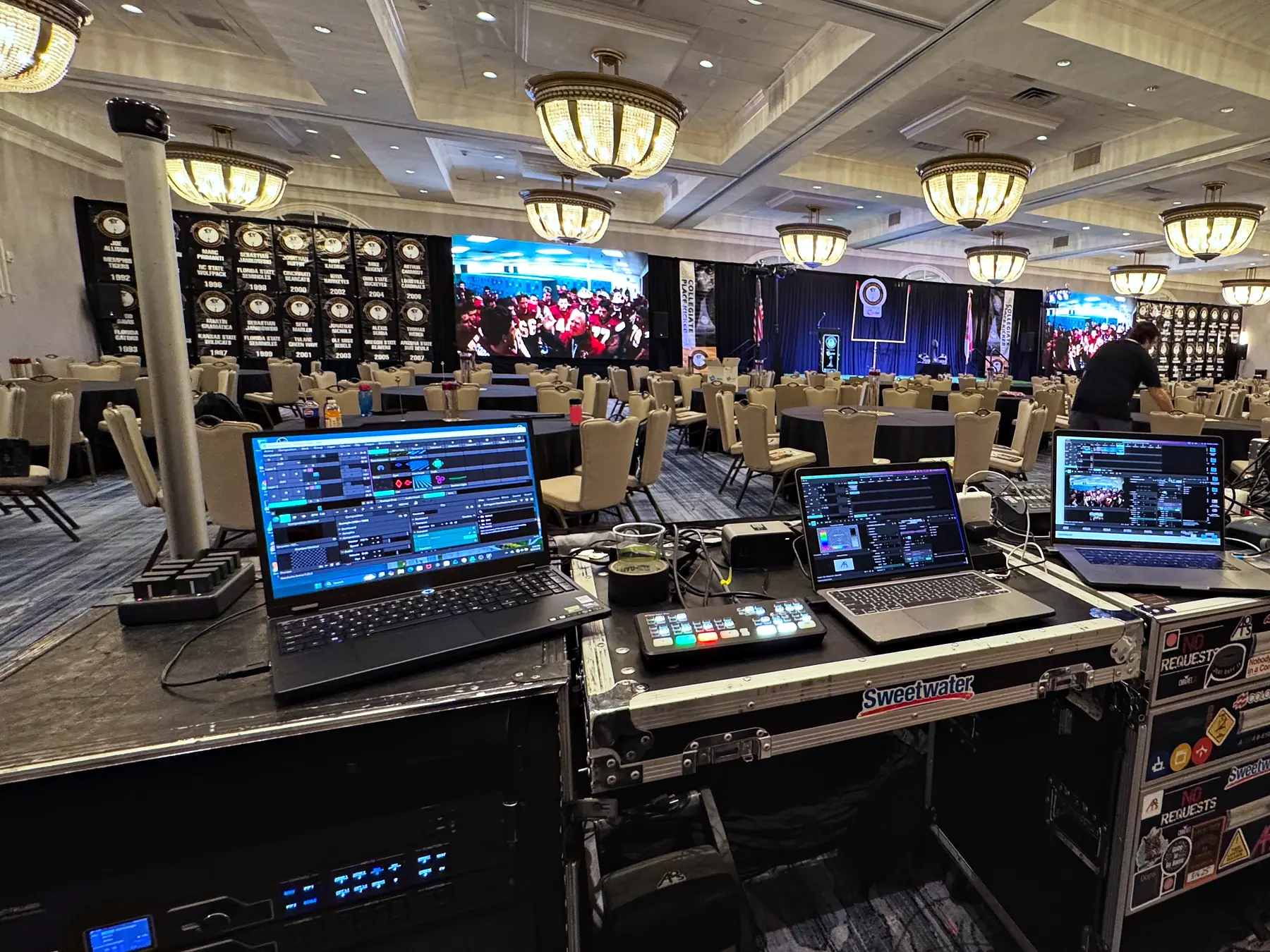
No client and no venue is named here, and there is no headcount, no date and no award count. What was supplied is — the live stream, the sound, the video walls and the pipe and drape, at a sports awards gala in West Palm Beach. Every count in the arithmetic above is a worked example with the steps left in, so it can be rerun against a different room and a different running order.
Awards night, gala, launch or a party on a lawn — the method does not change. The room and the schedule decide the design, and the equipment list is what falls out at the end of that rather than what goes in at the start.
Call (561) 750-4070 or email [email protected]. If you would rather see how the number is arrived at first, how we scope a project sets out the nine drivers in the order they move an estimate.