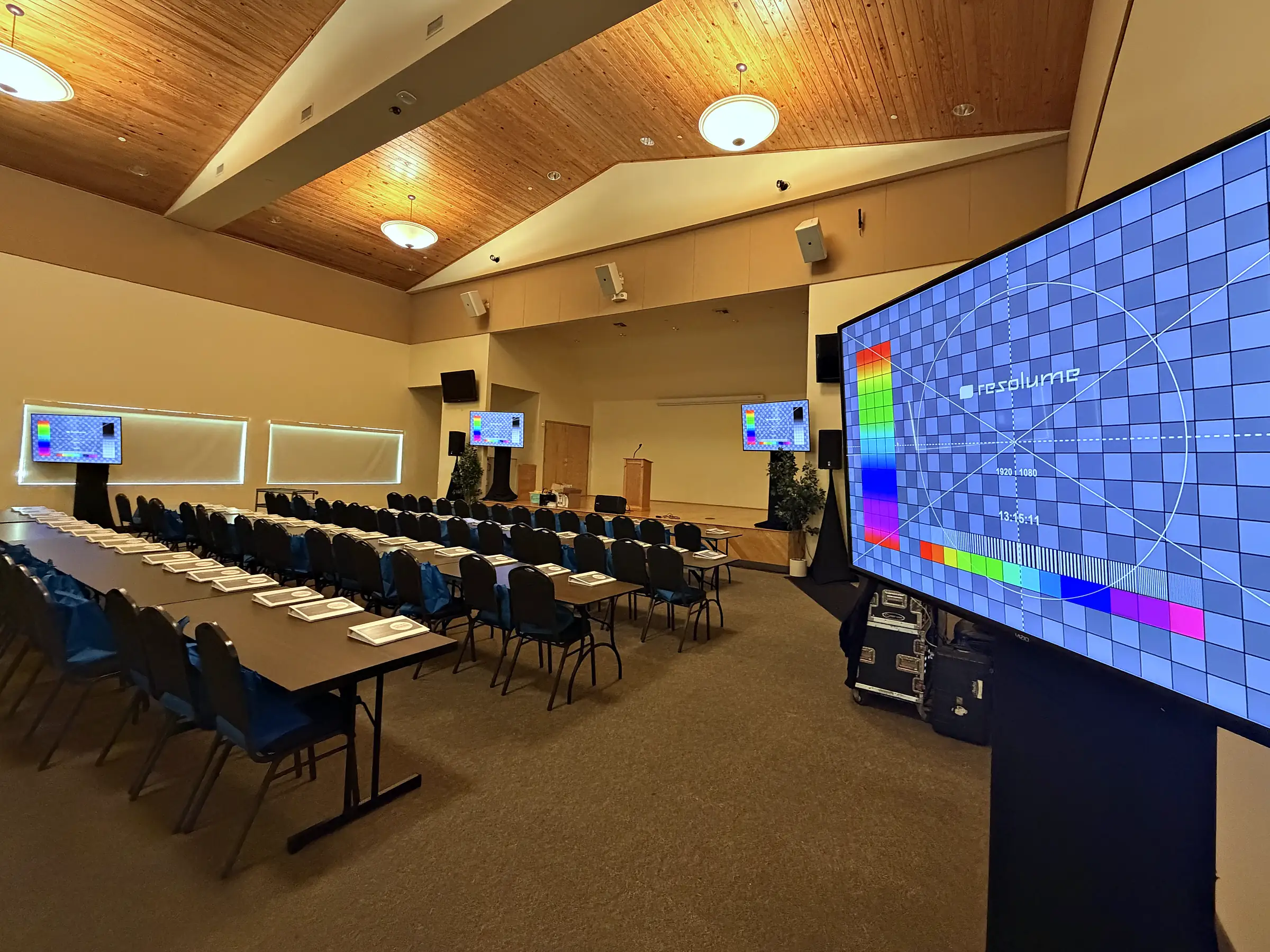
The keynote gets the budget. The breakout gets the headcount.
A multi-segment program spends an hour or two on a main stage and the rest of the day split across several smaller rooms running at once — and a design built for the stage does not simply scale down to fit them.
A general session is specified once, for one room, and it gets the deepest design attention because it is the room a client walks into first. A breakout is specified several times, for several rooms, on the same afternoon — and it is easy to treat each one as a smaller version of the same problem, with a smaller display and a smaller speaker doing the same job at a reduced scale.
That is the wrong model, and the rest of this page is why. A shallow room changes what the 8:1 rule actually asks for, not just the number it returns. A room this size wants coverage, not throw, out of its sound. Most breakouts run without anybody at a desk once the session starts. And because the same slot usually repeats down the hall in the room next door and the one after it, whatever gets decided here gets decided once and multiplied — which is a different design problem from the one a single, well-staffed main stage presents.
The same rule that sizes a 40-foot wall sizes a 52-inch panel.
The furthest-viewer rule does not care whether the room is a ballroom or a breakout — it is depth divided by eight either way. A shallow room is just a smaller answer to the same division.
What 8:1 asks for, at breakout-room depths — a worked example, not this room’s own measurements
| Depth to the last chair | Minimum image width (depth ÷ 8) | Nearest 16:9 diagonal |
|---|---|---|
| 20 ft | 2 ft 6 in | ≈ 34 in |
| 30 ft | 3 ft 9 in | ≈ 52 in |
| 40 ft | 5 ft | ≈ 69 in |
Divide the depth by eight for the width, the same arithmetic this site works for a full ballroom. A commercial flat panel ships 16:9, and a 16:9 panel’s diagonal is its width times about 1.147 — the square root of 16² plus 9², divided by 16 — so a width from this table converts straight to a diagonal a manufacturer actually builds. At the depths a breakout room is usually held to, the rule does not clear the size of a commercial panel, it lands inside it — which is the opposite of what the same rule does to a 150-foot ballroom, where it asks for something wider than any single panel comes.
That is why a flat panel wins over a built wall here: past a certain depth a video wall is the only way to reach the width the rule asks for, and below it a wall is more surface than the room needs, assembled from more pieces than a single panel that already exists.
Mounting is the other half of the decision, and it has nothing to do with the rule. A hotel’s breakout rooms are almost always subdivided by an airwall, or finished to a standard the banquet contract does not let anybody drill into — so the panel goes up on truss, on its own base, rather than on a wall bracket. The same rig comes back down and stands in a differently shaped room the next morning, which a bracket screwed into a specific wall cannot do.
Where these figures come from
- The 8:1 furthest-viewer rule — one foot of image width per eight feet of viewing distance, the industry standard and our own published figure
- The same rule worked for a full ballroom, where it asks for more than one panel can give it — /work/conference-video-wall-line-array-full-house
A deep room needs throw. A breakout needs evenness.
The argument for an array over a stack is about what happens to level over distance. At breakout depths there is not enough distance for that argument to matter.
The case for a line array on this site is built on distance: a point source loses about 6 dB every time the distance to it doubles, a line source loses about 3, and that gap is what a deep room needs solved. A breakout room rarely gives sound more than thirty or forty feet to travel, which is not enough doublings for the difference between the two to be the thing that decides whether the back of the room can hear.
What a shallow, wide room asks for instead is coverage without a hole in it — no seat sitting between two sources at a level noticeably lower than the seat next to it, and no seat close enough to one source to be uncomfortably loud relative to the rest of the room. That is answered by several smaller, distributed sources spread across the room rather than by one louder pair aimed down the length of it — the same "distributed systems" line this site already lists alongside line arrays, because they answer different rooms rather than different budgets.
The practical consequence is a simpler signal path. A distributed system built for even coverage is normally run from one feed at one level, because the goal is uniformity rather than a mix that changes moment to moment — which is also why a breakout does not usually carry a separate front-of-house position the way a general session does.
Where the distance argument is worked in full
A general session has an A1 in the room. A breakout usually does not.
Staffing an operator into every parallel room on a schedule does not scale, so a breakout is built to be correct on its own rather than watched.
A ballroom general session has an A1 and often an A2 within reach of the desk for the length of the program, ready to catch a dropped input or ride a level. A conference running five breakouts at once, each with its own presenter and its own hour-long slot, is a different staffing problem — putting a dedicated operator in every room multiplies the crew by the room count for a session most planners are not budgeting an operator into.
So the system is built to need nobody watching it rather than to reward somebody who is: an input that senses a laptop the moment it is plugged in instead of waiting to be switched, one volume that is already set correctly rather than one a presenter is expected to find, and a display that holds a known, deliberate image between sessions rather than a blank or an error screen a nobody-in-the-room state would otherwise leave up. The presenter runs their own laptop and their own clicker, and the room is specified so that is enough.
The math above is one room. The schedule is usually five.
A conference with several breakout slots is the same design question asked several times on the same afternoon, and the published labor minimums are the honest reason it is answered once rather than staffed room by room.
A ninety-minute breakout session is not a ninety-minute cost, for the same reason it is not on a general session: the Greater Fort Lauderdale / Broward County Convention Center’s published labor card sets a four-hour minimum on every call, including load-in and strike, and an eight-hour minimum on an operator specifically. Run that arithmetic once across a schedule of five parallel breakouts, each wanting its own operator for a ninety-minute slot, and the minimums compound by the room count rather than by the minutes actually used.
That is the practical argument for the room built to run itself in section 04, and for a design that is drawn once and carried into every room on the schedule rather than redrawn for each one: the fewer decisions that vary from room to room, the fewer calls a crew has to make, and the labor card’s minimums are what make that arithmetic matter rather than being an efficiency nicety.
Where the minimums and the dollar arithmetic are worked
Send the room count and the depth to the back chair.
How many rooms are running the same slot, how deep each one is, and whether an operator is in the budget decide the panel size, the sound and the staffing before anything else does.
No client, no venue and no headcount goes on this. The city does, because it is a city, and what we supplied does, in the words it was described to us in.
Send the room count and the depth to the back chair, and the answer comes back sized off your own numbers rather than the worked example above.
Call (561) 750-4070 or email [email protected]. If you would rather see how the number is arrived at first, how we scope a project sets out the nine drivers in the order they move an estimate.